![Clevry_Logo_RGB_TSSC.png]](https://help.clevry.com/hs-fs/hubfs/Clevry/Logos/Clevry%20Logo%20Tagline/Clevry_Logo_RGB_TSSC.png?height=40&name=Clevry_Logo_RGB_TSSC.png)
Most CPQ users prefer to take full advantage of the flexibility of the instrument by creating their own bespoke personality questionnaires (which is the approach we recommend).
Each scale in the CPQ is a discrete, indivisible entity comprising 6 items as standard. The scales can be selected from the library in any permutation, although a minimum of 9 scales are needed to create a questionnaire. A bespoke CPQ contains only those scales that are relevant to your needs. As a rule of thumb, scales on average take about 1 minute to complete, meaning that your bespoke questionnaire will take around the same number of minutes to complete as there are scales.
Bespoke personality questionnaires are created through the Clevry platform’s personality questionnaire builder. When creating your own personality questionnaire, you will need to follow the below steps:
- Conduct a job analysis
- Choose a language
- Name your questionnaire
- Choose your CPQ scales
- Create your profile chart structure
- Job match your personality questionnaire
- Choose a norm group
The following pages provide detailed instructions on the procedure for creating a CPQ through the platform. Alternatively, if you’re starved of human contact, we’re more than happy to arrange a short platform onboarding session with you. Just contact us at support@clevry.com. For now though, read on!
The Clevry platform is designed to enable you to become self-sufficient when creating bespoke questionnaires; there is no requirement to involve Clevry in the design of your questionnaire, but we are happy to assist in any way that will help you.
Step 1: Conduct a Job Analysis
What is a job analysis?
We strongly recommend that the very first step you should take when creating your own bespoke personality questionnaire is to conduct a job analysis into the role you are assessing. Job analyses define the skills, knowledge, and attributes needed to perform the job well. They define what the person needs to do to fulfil the requirements of the job, in behavioural terms.
Why is it important?
It is critical to ensure that the right type of test is selected, and that it measures the critical competencies for the job. Conducting a job analysis not only enables you to create a personality questionnaire that possesses content validity, but it also makes your assessment process more legally defensible.
How do I conduct a job analysis?
To conduct a job analysis, you will first need to carry out discovery into the role itself. There are a range of job analysis methods available, including:
- Job analysis interviews – conducted with incumbents and managers.
- Critical incidents – exploring typical demands of the role and the critical skills and behaviours for responding effectively.
- Focus groups - conducted with incumbents and managers.
- Repertory grids – very effective technique for ‘looking down’ on a job with a line manager.
- Observation – watching performance in the role.
Job analysis research often comprises a combination of these techniques as appropriate. You should also draw on any additional sources of information about the role or process such as existing job analysis research, job descriptions, competency frameworks, leadership models, or organisational values.
Following this, you should then qualitatively review your findings to identify key themes in relation to personal attributes. These personal attributes should then be categorised as either essential or desirable:
- Essential attributes – critical to effective performance in the role. Clearly differentiate between top performers and mediocre performers.
- Desirable attributes – nice to have but not critical. Do not clearly differentiate performers in the role.
If you would like help conducting a job analysis, our Business Psychologists are always on hand. Simply get in contact with us at support@clevry.com.
Step 2: Choose a Language
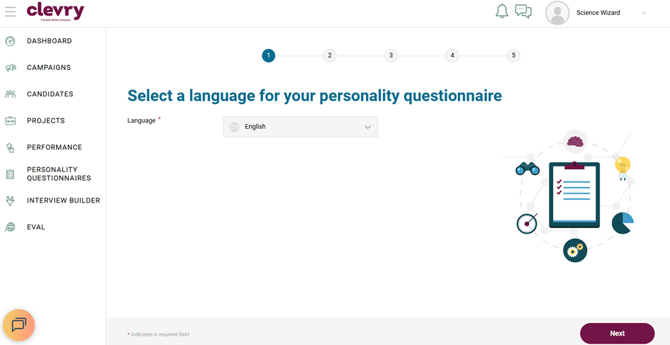
When creating your bespoke personality questionnaire in the Clevry platform, the first thing that you will be asked to do is to specify what language the questionnaire will be in. The CPQ Nova is currently only available in English. However, we are constantly adding new language versions to our library. Information relating to the translated versions of the CPQ are not included in this article, the focus of which is the default, English-language version of the instrument.
Step 3. Name Your Questionnaire
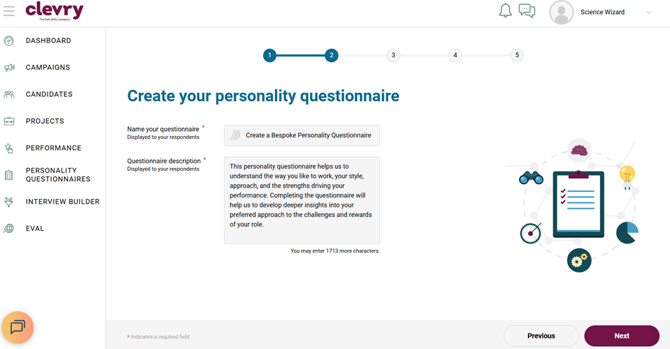
Next, you have the opportunity to give your questionnaire a name. Personality questionnaire names tend to range from straightforward, to pedantically descriptive, and beyond to the flowery, exotic, and those with classical allusions (c.f. 16PF, Occupational Personality Questionnaire, Wave, Orpheus etc).
One would have to stare at the name ‘CPQ’ before one’s pulse quickened; fortunately, you can name your bespoke personality questionnaires whatever you like.
This is more than an exercise in shallow branding; clearly naming your bespoke questionnaire after the organisation, role, or process for which it will be used will encourage perceptions of face and content validity among candidates and other assessment stakeholders. Your chosen name will appear throughout the candidate journey and on candidate reports and profile charts.
At this stage, you can also provide a description for your personality questionnaire which will be shown to candidates. By default, the Clevry platform will automatically fill in a generic description for you. However, should you wish to, you can alter this to suit your needs and tailor it to the questionnaire that you have designed.
Step 4: Choose Your CPQ Scales
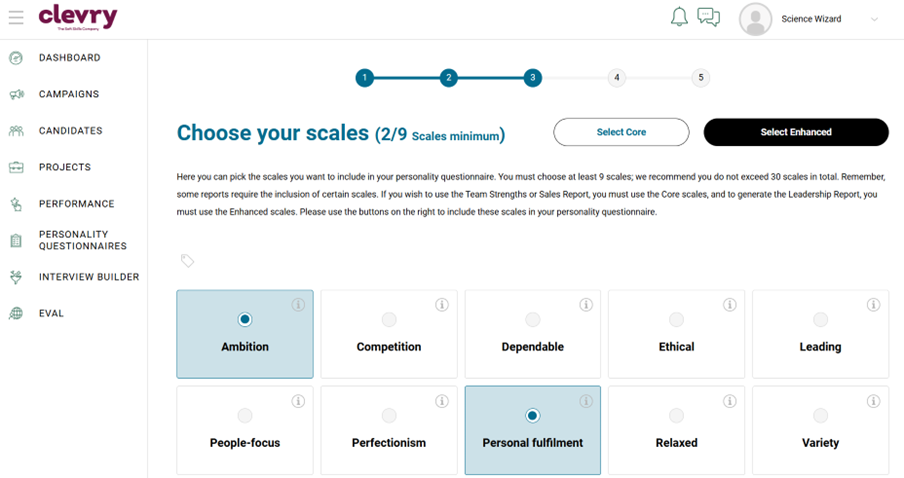
At this stage you can use the output of your job analysis to select the CPQ scales that you would like to assess candidates’ personality with. Keep in mind that the more scales you select, the longer your questionnaire will be. If you have a very lengthy selection process, then you should aim to keep your personality questionnaire relatively short so as to improve candidate experience. As a guide we recommend a maximum of around 30 scales, so as to minimise fatigue or boredom, and a minimum of 9, in order to gain a more holistic understanding of each candidate’s personality.
Broad Range of Scales
Remember that each CPQ scale measures a narrow trait of personality. In order to get a broader understanding of someone’s personality, you will need to include enough scales targeting the areas you are interested in assessing. As such, try to ensure you select scales from a number of different areas. Avoid choosing scales that belong to just one dimension (e.g., only People Soft-Skills), as this will provide you with a very narrow picture of candidates’ personality.
Both Ends of the Scale
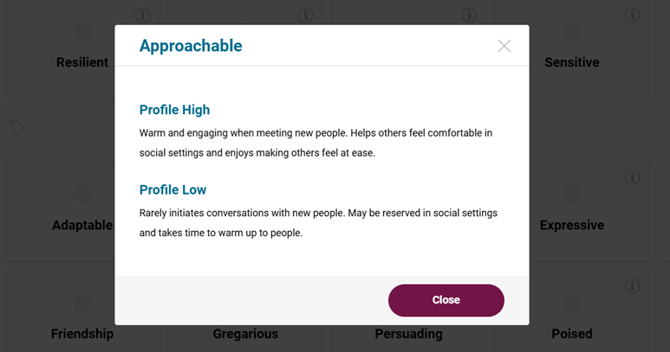
When choosing scales, remember to look at both the high and low end definitions. The high end definition may not necessarily align with what you are seeking in a candidate, but the low end may represent a key trait that you are looking out for. Simply click on the ‘I’ button on each scale to see the description (or take a look at Scale Descriptions here).
Positive and Negative Traits
Although there is no such thing as ‘right or wrong’ in personality, there are some traits that will be desirable for a particular role (positive traits) and some that will not be suitable at all (negative traits). It may be tempting to focus solely on personality traits that are desirable for the role that you are assessing for. Keep in mind that not only are we looking to assess these desirable traits, but we’re also seeking to identify any traits that may be less suitable for the role itself. A personality questionnaire that comprises scales to assess both desirable and less suitable traits will be more predictively valid, enhancing success in the role by identifying not only strengths but also derailers.
Further Support
The Business Psychologists at Clevry are available to provide guidance for CPQ users on what approach might be most effective in their specific assessment context and to provide assistance with implementing the design process. For further help and support, please contact Clevry at support@clevry.com.
Step 5: Create Your Profile Chart Structure
The scales in the CPQ library are structured around the five elements of personality measured by the CPQ (see The CPQ Structure of Personality for more detail). These elements are used as default profile chart headings by the CPQ. This means that when you create your bespoke questionnaire you can structure the profiles and reports generated as a result of your assessments using these five headings:
- People soft-skills
- Cognitive soft-skills
- Emotion soft-skills
- Motivation values
- Culture-fit values
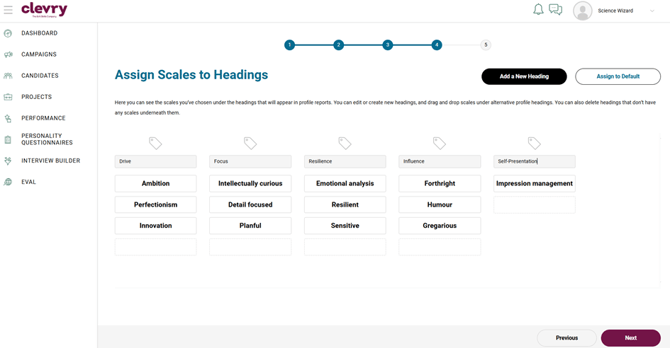
You can decide the order in which your selected scales appear under each heading. But you can go much further in terms of tailoring your questionnaire and its profiles and reports!
You can choose to remove any of the five default profile headings if you are not interested in including scales relating to that element of personality in your questionnaire. For instance, you can choose to remove the Cognitive soft-skills heading if no scales from that area are to be included.
And you can go further still. You can remove all of the five default CPQ headings and replace them with your own. These may be drawn directly from your own role-profiling research, competency framework, leadership model, organisational values, or development intervention content. Once you have specified your own headings you simply select the CPQ scales you want to include under each one by dragging and dropping them into place.
Step 6. Job Match Your Personality Questionnaire
If you are using your personality questionnaire as part of a selection process, it is essential that you job match your assessment. Job matching allows you to indicate what your ideal candidate would look like on each of your chosen scales using a sliding scale to determine the degree of fit with the target role. Remember in Step 4 where we mentioned that your ideal candidate may be someone who represents the lower end of a scale? This is what job matching is for. Find out more about job-matching here.
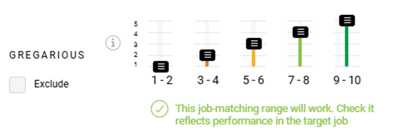
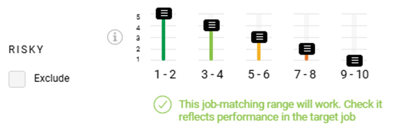
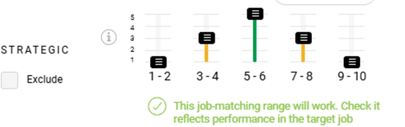
Use your job analysis to determine how to job match your personality questionnaire. Do not base this process on subjective opinions, but instead ensure that you have conducted a rigorous job analysis to inform this stage. You can tell the system whether you are looking for someone who scores on...
… the high end of a scale:
… the low end of a scale:
… the middle of a scale:
… or even whether to exclude a scale from job-matching (for example, if you are interested in understanding a candidate’s personality in this area, but it is not essential to performance)!
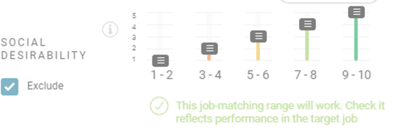
Please note: The Impression-management scale will always be excluded by default from job-matching, as this is purely to inform you of the candidate’s response style and should not be used to make any decisions.
Upon designing your personality questionnaire, you will be given the opportunity to job match it following step 5. Alternatively, you can go into the ‘Personality Questionnaires’ tab on the Clevry platform, and job match any personality questionnaire you are using at any time.
Step 7. Choosing a Norm Group
Once you have designed your questionnaire and you’re ready to use it as part of a campaign or project, you can select from a range of available CPQ norm groups.
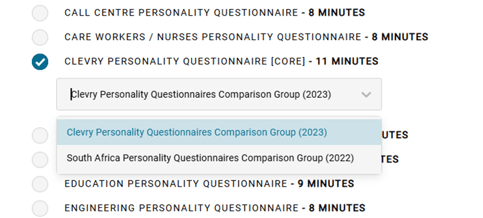
Alternatively, Clevry are also able to construct bespoke norm groups based on data from your previous candidates passing through the platform. It is important to note that a pre-requisite for creating a bespoke norm group is having data from at least 200 candidates to use, in order to make it a reliable comparison group.
If you want to use a norm group specific to your industry, we may be able to create a norm group from already available candidate data on the Clevry platform. Please contact us at support@clevry.com if you would like to discuss this further.
For more information concerning norm groups please refer to our Creating a Norm Group article.
A Note on Industry/Role Specific Norm Groups
Although we are happy to support in the creation of bespoke norm groups, Clevry do not recommend utilising industry or role specific norm groups, as they can exaggerate small differences between candidates that are not all that different in real life.
For example, it is reasonable to expect that anyone working in a sales driven role is likely to be highly Financially-driven. A sales specific norm group, however, would exaggerate any differences between these salespeople. This means that someone who is only slightly more financially driven than their counterpart may appear to be much, much more financially driven. These small differences in real life are unlikely to impact job performance, but the distorted scoring is likely to impact our decision making, and ultimately reduce the predictive validity of our assessment.
Step 8. Use Your Personality Questionnaire!
The final step to using your bespoke personality questionnaire, is to incorporate it into your selection and/or development processes.
You can create a campaign or project in the Clevry platform to use your questionnaire either by itself, or alongside Clevry’s other assessments (e.g., cognitive ability tests, Situational Judgement Tests etc).
If you need a reminder on how to create a Campaign, skip to 1 minute 25 seconds in the Clevry Platform Demonstration video here. If you’d still like some additional help after watching this video, simply get in touch at support@clevry.com.